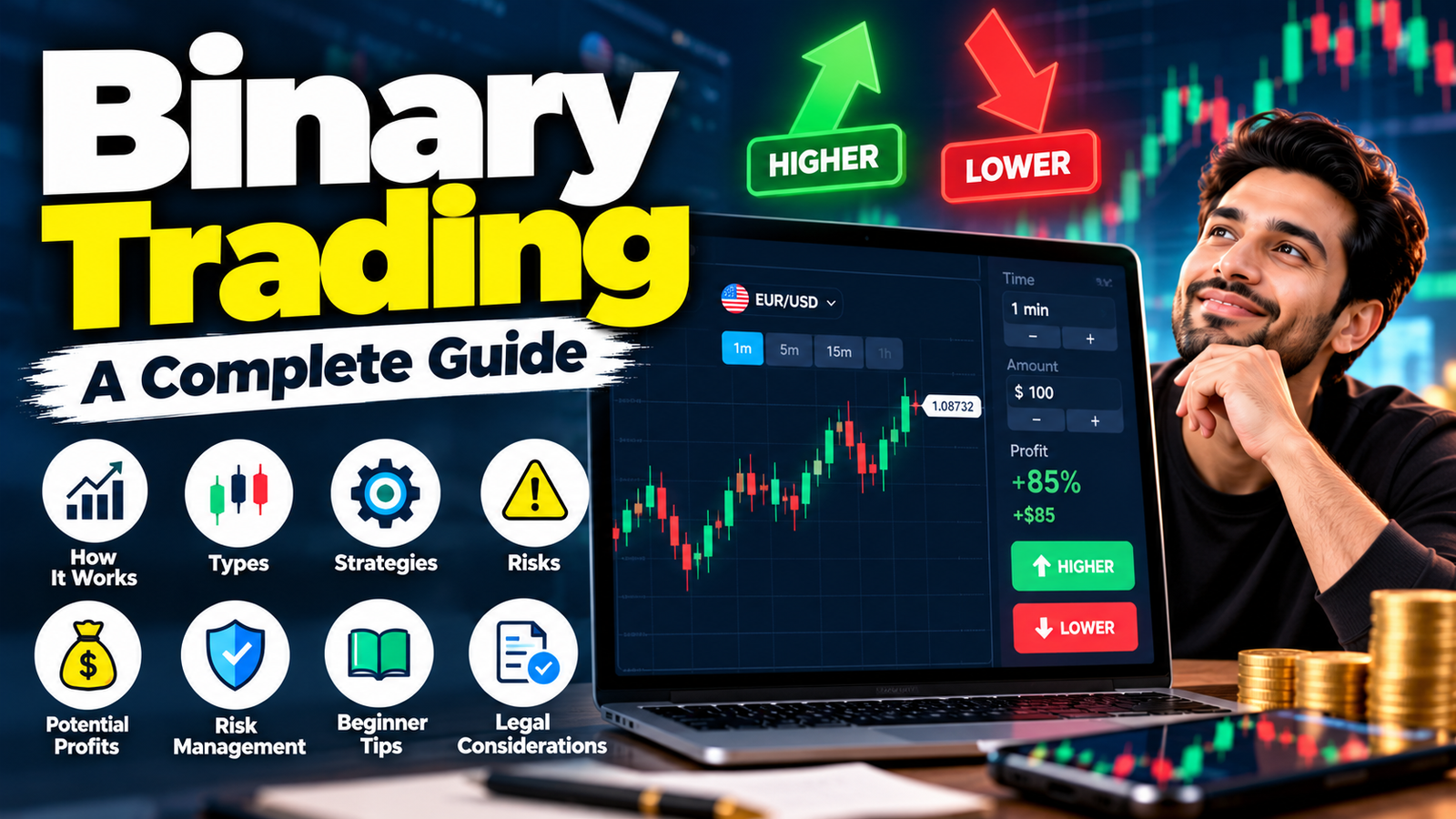
Binary trading has become a popular topic among people interested in online trading and financial markets. With the growth of digital trading platforms, many beginners are exploring ways to trade price movements in assets such as currencies, stocks, commodities, and market indices. Binary trading is often presented as a simple way to speculate on whether an asset’s price will rise or fall within a specific period.
However, simplicity does not mean that binary trading is easy or profitable. These trades can result in the loss of the entire amount invested in a position, and short-term price movements are difficult to predict consistently. Understanding the mechanics, risks, and limitations of binary trading is essential before considering any participation.
This guide explains what binary trading is, how it works, the different types of markets involved, common trading approaches, risk management principles, and the mistakes beginners should avoid.
What Is Binary Trading?
Binary trading generally refers to trading binary options, a type of financial contract with two possible outcomes at expiration. Depending on the contract, the trader receives a predetermined payout if a specified condition is met or loses the amount staked if the condition is not met.
A common example is a higher-or-lower contract. A trader predicts whether the price of an asset will be above or below a specified level at a particular expiration time.
For example, suppose a platform offers a binary contract on the EUR/USD currency pair. The trader predicts that the price will be higher after one minute. If the contract’s settlement conditions are satisfied, the trader receives the stated payout. If the prediction is incorrect, the trader loses the stake, subject to the contract’s terms.
Unlike conventional investing, where returns may depend on the size of a price movement, binary options generally have predefined outcomes. A correct prediction does not necessarily produce a larger payout simply because the market moved significantly farther in the predicted direction.
It is also important to distinguish regulated exchange-traded binary options from fixed-payout products offered by online platforms. Their structures, legal status, and investor protections can differ substantially.
How Does Binary Trading Work?
Binary trading typically follows a straightforward process, although the financial risks can be considerable.
1. Choose an Underlying Asset
The trader selects an asset or market on which the contract is based. Common examples include:
- Currency pairs, such as EUR/USD.
- Stock market indices.
- Individual stocks, where offered.
- Commodities, such as gold or crude oil.
- Other financial instruments supported by the platform.
The selected asset’s price determines whether the contract meets its settlement condition.
2. Select the Contract Direction
In a basic higher-or-lower contract, the trader predicts whether the settlement price will be above or below a specified reference price.
Some contracts use different conditions, such as whether the price will touch a particular level. The exact rules depend on the product.
3. Choose the Expiration Time
The expiration time determines when the contract’s outcome is evaluated. Some platforms offer contracts lasting seconds or minutes, while other products may have longer durations.
Very short expiration periods can be particularly challenging because market noise, spreads, execution differences, and rapid price changes can have a substantial effect on the result.
4. Determine the Stake
The stake is the amount placed on the trade. Before entering a position, traders should understand the maximum possible loss, the potential payout, and any applicable fees or settlement conditions.
5. Wait for Settlement
At expiration, the platform evaluates the contract according to its rules. The trader either receives the specified payout or loses the stake if the contract’s condition is not satisfied.
Because outcomes are generally fixed, an accurate prediction is not enough on its own to guarantee long-term profitability. The payout structure must also compensate for losing trades.
Understanding Payouts and Profitability
One of the most important aspects of binary trading is understanding the relationship between the payout and the probability of winning.
Suppose a trader places a ₹1,000 stake on a contract offering an 80% profit payout.
- If the trade wins, the profit is ₹800, and the original stake is returned.
- If the trade loses, the loss is ₹1,000.
- If the trade wins and loses equally often, the overall result is negative.
In this example, ignoring fees and other complications, the trader must win more than approximately 55.56% of trades to break even over the long run.
The break-even win rate can be calculated using the following formula:
Break-even win rate = Stake ÷ (Stake + Potential profit)
For an 80% profit payout:
Break-even win rate = ₹1,000 ÷ (₹1,000 + ₹800) = 55.56%.
This means that a trader winning 50% of such trades would lose money over time, even though half of the predictions were correct.
The calculation assumes the stated payout is a profit percentage, losing trades lose the full stake, and there are no additional fees. Actual contract terms may differ.
Common Types of Binary Trading Contracts
Different binary contracts use different settlement conditions.
Higher-or-Lower Options
These contracts require the trader to predict whether the asset’s price will finish above or below a specified reference level at expiration.
They are among the easiest binary contracts to understand, but short-term price movements remain uncertain.
Touch or No-Touch Options
These contracts depend on whether the asset’s price reaches a specified price level before expiration.
A touch contract may pay if the target level is reached, while a no-touch contract may pay if the level is never reached during the contract period. The precise settlement rules vary.
In-or-Out Options
Some contracts require the price to finish within or outside a defined range.
The result depends on the asset’s settlement price relative to the boundaries specified in the contract.
Although these products differ in structure, they share an important feature: the outcome depends on predefined conditions rather than simply the overall direction of a long-term investment.
Markets Used in Binary Trading
Binary contracts may reference several financial markets, depending on the product and platform.
Forex markets: Currency pairs such as EUR/USD and GBP/USD are influenced by interest rates, economic data, central bank decisions, and geopolitical developments.
Stock indices: Indices represent groups of stocks and may respond to corporate earnings, economic conditions, and market sentiment.
Commodities: Assets such as gold and crude oil can be influenced by supply and demand, inflation expectations, geopolitical risks, and currency movements.
Individual stocks: Certain products may reference the prices of individual companies. Their prices can react sharply to earnings announcements, business developments, and other news.
Understanding the underlying market can provide useful context, but market knowledge cannot eliminate uncertainty or guarantee correct predictions.
Binary Trading Strategies
Traders sometimes use technical analysis, fundamental analysis, and structured trading rules when evaluating binary contracts. None of these methods guarantees success.
1. Trend Analysis
Trend analysis involves examining whether an asset’s price has generally been moving upward, downward, or sideways.
Traders may use price charts, moving averages, and swing highs and lows to describe market direction.
However, a trend observed over a longer period does not guarantee that the price will move in the same direction over the next few seconds or minutes.
2. Support and Resistance
Support and resistance refer to price areas where buying or selling activity has previously influenced the market.
Traders use these levels to study possible reactions, breakouts, or reversals. Nevertheless, prices can move through these areas unexpectedly, particularly during volatile market conditions.
3. Candlestick Analysis
Candlestick charts display information about an asset’s opening, closing, high, and low prices over a selected period.
Some traders study patterns such as engulfing candles, pin bars, and doji candles to understand market behaviour.
These patterns should not be treated as reliable predictions on their own. Their interpretation depends on context, and historical patterns do not guarantee future outcomes.
4. Fundamental Analysis
Fundamental analysis involves examining economic reports, central bank announcements, inflation figures, employment data, and other events that may influence market prices.
Such information can help explain market movements, but major announcements can also produce unpredictable price changes and execution risks.
5. Trading Journals and Testing
A trading journal records the reasoning behind each trade, the contract conditions, the payout, the result, and any relevant market circumstances.
Keeping records can help identify repeated mistakes and distinguish a genuine performance pattern from a short sequence of lucky outcomes.
Testing a method using historical or simulated data may be useful, but backtesting and demo results do not guarantee success with real money.
Risk Management in Binary Trading
Risk management is essential because losing trades can consume capital quickly.
Set a Strict Budget
Never use money needed for essential expenses, debt repayments, emergency savings, or family responsibilities. Binary trading should not be treated as a dependable source of income.
Avoid Martingale Strategies
Martingale systems increase the stake after a loss in an attempt to recover previous losses. This approach can cause rapidly escalating losses and does not remove the underlying mathematical disadvantage of an unfavourable payout structure.
Understand the Payout Before Trading
Always calculate the potential profit, maximum loss, and break-even win rate before evaluating a contract. A high advertised payout does not automatically make a trade attractive.
Avoid Emotional Decisions
Repeatedly trading to recover losses can lead to impulsive decisions and excessive exposure. Establishing clear limits before trading can help prevent emotional escalation.
Be Careful With Leverage and Deposits
Some platforms offer additional features, bonuses, or trading arrangements that can introduce restrictions or additional risks. Read the terms carefully and avoid depositing money simply to qualify for promotional offers.
Risk management can limit some avoidable mistakes, but it cannot make an inherently risky product safe or guarantee positive returns.
Is Binary Trading Legal?
The legality of binary trading depends on the country, the specific product, the platform, and the applicable financial regulations.
Some jurisdictions restrict or prohibit the marketing, sale, or distribution of binary options to retail customers. Others permit certain products through authorized providers under specific rules.
In India, anyone considering a binary-style online trading platform should verify the current requirements and warnings issued by the Securities and Exchange Board of India (SEBI) and the Reserve Bank of India (RBI), where relevant. They should also confirm whether the specific provider and product are legally permitted for Indian residents.
A platform being accessible through a website or mobile application does not establish that it is authorized to offer its products in India. Offshore platforms may provide limited legal recourse, and customers can face difficulties recovering funds or resolving disputes.
Do not assume that a platform is safe merely because it advertises high payouts, displays testimonials, or offers a demo account.
Common Mistakes Beginners Should Avoid
New traders can be especially vulnerable to unrealistic expectations and misleading marketing.
Common mistakes include:
- Believing that binary trading guarantees quick profits.
- Entering trades without understanding the payout structure.
- Using borrowed money or essential household savings.
- Increasing stakes after losing trades.
- Relying entirely on social media signals or promotional videos.
- Assuming that demo-account performance will translate into real-money results.
- Ignoring local regulations and platform authorization.
- Failing to understand withdrawal conditions and dispute procedures.
A disciplined approach begins with understanding the product and its risks rather than searching for a guaranteed winning strategy.
Conclusion
Binary trading is a form of financial speculation in which a contract’s outcome depends on whether specified conditions are met at a particular time. Its predefined payouts and straightforward interface can make it appear simple, but the financial risks are significant.
To understand binary trading properly, beginners should learn how contract settlement works, calculate break-even win rates, study the underlying market, and recognize the limitations of technical and fundamental analysis.
Most importantly, traders should investigate the legality and regulatory status of any platform before considering participation. Short expiration periods, full-stake losses, unfavourable payout structures, and unreliable providers can make these products particularly risky.
There is no guaranteed strategy for winning binary trades consistently. A cautious approach, realistic expectations, and awareness of regulatory protections are essential. For people seeking to build long-term financial security, it is worth comparing these risks with more transparent, regulated investment alternatives before committing any money.